COMPONENT C
INSTITUTIONAL STRENGTHENING AND PROJECT MANAGEMENT.
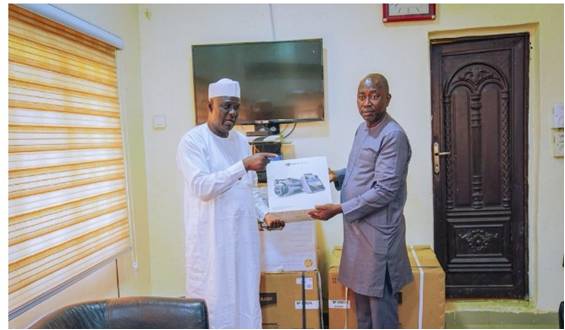
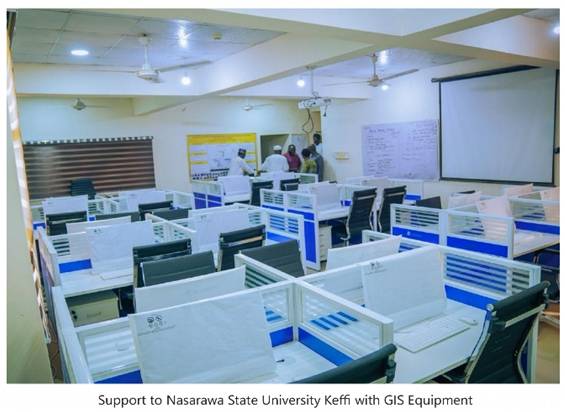
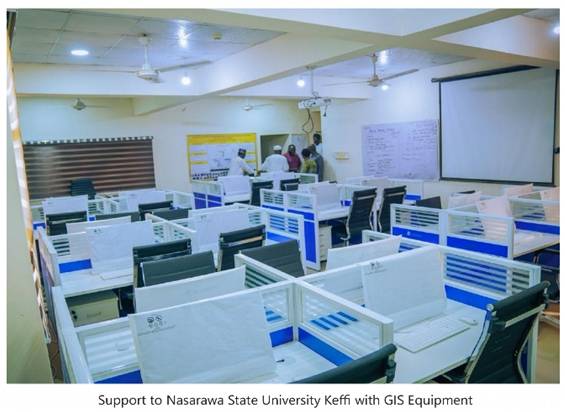
- The Nasarawa State ACReSAL Project extended ICT and GIS support to several tertiary institutions which include:
- Nasarawa State University, Keffi
- Federal University, Lafia
- College of Education, Akwanga
- College of Agriculture, Science & Technology, Lafia
- This support enhances their capacity for geospatial research, data generation, and training of students and professionals in environmental and climate-related disciplines. The investment also promotes the integration of scientific data into policy and planning processes.
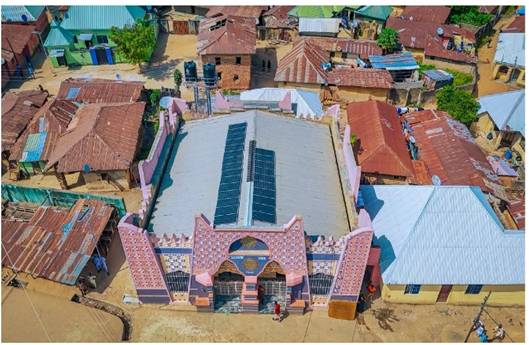
- The Project provided solar-powered lights to critical MDAs, partner institutions, and traditional rulers’ palaces across the State.
This initiative has improved night-time security, enhanced public safety, facilitated economic activities, and strengthened government presence in local communities.
Beneficiaries include:
Emir of Lafia, Emir of Gudi, Chun Mada of Akwanga, Oriye-Rindre of Wamba, Aren Eggon of Nasarawa Eggon, Andoma of Doma, Emir of Keana, Emir of Awe, Nasarawa State University, Keffi, College of Agriculture, Science & Technology, Lafia, Ministry of Women Affairs, NCDC Office, DSS Office, Nigeria Police Force Command, Lafia, and Ministry of Environment, Lafia
- IT students are posted to the ACReSAL PIU for industrial training for capacity building.
- Capacity building of relevant MDA’s GIS staff and SPMU officers by Nasarawa State University
SUSTAINABILITY PLAN
1.Establishment of Agency
a. Land restoration (Erosion control, gully rehabilitation and watershed management)
Action:
- Establish and empower watershed management committee for site oversight..
- Community led surveillance to prevent farming, burning or grazing on restored sites.
b. Agricultural & livelihood activities. (Climate Smart Agriculture, degraded land restoration.
Action
- Upscale farmers-managed natural regeneration and agroforestry plots.
- Access to revolving fund and off takers agreement
c. Water infrastructure (Boreholes, reservoirs, Solar Schemes, flood/water Harvesting.)
Action
- Establish water user association for every water facility.
- Train care takers on pump, solar maintenance.
d. Forest and biodiversity.
Action
- Community forest guards and surveillance team appointed by traditional councils.
- Establishing of woodlot and community nurseries.
CONFLICT RECORDED IN KEY PROJECT SITES
Brief description of conflict
Recurring conflict between farmers and herders has been driven by competition over scarce natural resources such as water points(stream) These pressures intensified as land degradation, expanding cultivation, and limited access to traditional grazing routes created tension between both groups.
How was it resolved
The NS ACReSAL Project introduced targeted interventions to reduce pressure on natural resources and strengthen community resilience. The project provided solar-powered bore holes to improve water availability for both humans and livestock, thereby reducing competition at shared water points (stream).
Assessment of ACReSAL Project’s Component A
| S/N | Task / Activity | Sub-component | Status | Progress |
|---|---|---|---|---|
| 1 | Watershed/catchment management to reduce sedimentation | A2 | Ongoing | Storm water management control and afforestation activities in the two catchment areas of Doma and Toto |
| 2 | Irrigation development | A2 | Ongoing | 300 solar irrigation powered pumps provided in two catchment area LGAs – FLID aspect ongoing |
| 3 | Flood control and erosion works | A2 | Ongoing | Flood control works implemented across Lafia, Doma and Toto, providing great impact |
| 4 | Community sensitization on erosion control | A2 | Achieved | Several community sensitization sessions conducted across communities |
Assessment of ACReSAL Project’s Component B
| S/N | Task / Activity | Sub-Component | Status | Action |
|---|---|---|---|---|
| 1 | Micro-watershed planning (10 MWPs) | B1 | Ongoing | 10 micro-watershed plans cleared by the bank |
| 2 | Stakeholder identification for MWPs | B1 | Ongoing | Based on the ongoing plans, stakeholders are still being identified |
| 3 | Development, appraisal and validation of MWPs | B1 | Ongoing | 2 have been cleared and 8 have been developed, appraised and are awaiting validation |
| 4 | Community sensitization | B1 | Ongoing | Community sensitization is a continuous process |
| 5 | Formation/strengthening of community groups | B1 | Achieved | 132 CIGs have been registered, and capacity has been improved for all 132 |
| 6 | Peacebuilding initiatives | B1 | Achieved | Capacity built for ACReSAL staff and stepped down to EWER committee members on conflict resolution |
| 7 | Establishment of NRM Committees | B1 | Achieved | Landscape restoration management committees established in Nasarawa State |
| 8 | Development of GBV protocol | B1 | Achieved | Action plan developed and GBV committees inaugurated in selected health care facilities |
Assessment of ACReSAL Project’s Component B
| S/N | Task / Activity | Sub-Component | Status | Action |
|---|---|---|---|---|
| 9 | Community-based GRM | B1 | Achieved | Grievance Redress Committees (GRC) have been formed across the two micro-catchments (Doma and Toto) communities and trained on how to handle grievances in the community. |
| 10 | Capacity building (cohesion, conflict management) | B1 | Achieved | EWER committee capacity has been built and members are resolving conflicts. |
| 11 | Training of GBV service providers | B1 | Achieved | Service provider mapping conducted at the point of data collection. |
| 12 | Community GBV/GRM training | B1 | Achieved | Community GBV/GRM training and sensitization conducted across the two micro-catchments, while E-GRM App system refresher training is still ongoing. |
| 13 | Community waste management planning | B1 | Ongoing | Waste bins distributed in Nasarawa State across 13 LGA waste collection centres. Advocacy and sensitization on waste management and recycling ongoing. |
| 14 | Waste management groups formation | B1 | Ongoing | In the two catchments: Doma and Toto. |
| 15 | Community-led landscape restoration | B2 | Ongoing | Site preparation, planting and agroforestry integration carried out in Nasarawa State. |
| 16 | Engagement of technical partners | B2 | Achieved | FAO has been engaged. |
Assessment of ACReSAL Project’s Component B
| S/N | Task / Activity | Sub-Component | Status | Action |
|---|---|---|---|---|
| 17 | Site selection & phasing | B2 | Achieved | Sites have been selected and land restoration started in some sites. |
| 18 | Pre-planting operations | B2 | Ongoing |
Land preparation: land clearing, ploughing, soil testing. Nursery readiness. |
| 19 | Engagement of cooperatives | B2 | Ongoing | Farmer cooperatives mobilised for ownership and sustainability. Planting, maintenance, and monitoring agreements completed. Capacity building on climate-smart practices and agroforestry. Cooperatives linked to value chains for economic incentives (NTFPs, improved crops). |
| 20 | Training of trainers | B2 | Achieved | Training of trainers conducted in Abuja. This was the first FAO activity Nasarawa State participated in. |
| 21 | Finance for inputs & value chains | B2 | Achieved | Seeds, seedlings, and tractors purchased by states for land restoration. |
| 22 | Establish community nurseries | B2 | Achieved | Nasarawa State has established community nurseries to ensure seedlings are available (e.g. Akanga, Doma, Akwanga, Keffi, Nasarawa, Wamba). |
| 23 | Promote NTFP value chains | B2 | Achieved | Trainings conducted by FAO; locally available NTFPs identified (e.g. medicinal plants, fruits, nuts, baobab), and Nasarawa State has started implementation. |
Progress of Activities across Components
| S/N | Task / Activity | Sub-Component | Status | Action |
|---|---|---|---|---|
| 25 | Climate-smart rainfed agriculture | B2 | Ongoing | Nasarawa State is integrating agroforestry, distributing seeds of drought-tolerant, early-maturing crops, and organic manure storage facilities to reduce post-harvest losses. |
| 26 | Extension & technical assistance | B2 | Ongoing | 1,329 farmers have been identified and are receiving services through DPAE and collaboration with soil value chains. |
| 27 | Revolving funds establishment | B2 | Ongoing | 10 CRFMC were given soft loans of USD 25,000 each. |
| 28 | Community storage & processing facilities | B2 | Achieved | One Garri processing centre in Akwanga and one rice mill processing facility in Doma. |
| 29 | Farmer-led irrigation development | B2 | Ongoing | Distribution still ongoing and contacts continuing. |
| 30 | Water and soil conservation | B2 | NIL | |
| 31 | Improved crop varieties & climate technology | B2 | Ongoing | Nasarawa State has procured and distributed improved crop varieties to farmers. |
Progress of Activities across Components
| S/N | Task / Activity | Sub-Component | Status | Action |
|---|---|---|---|---|
| 62 | Procurement, FM, safeguards oversight | C2 | Achieved | |
| 63 | Monitoring & evaluation systems | C2 | Ongoing | M&E manual in place. Management Information System (MIS) with both offline and online data entry capabilities is functional. Tracking of project implementation is a continuous process. |
| 64 | Communication & mobilization | C2 | Ongoing | The project has carried out several community engagement sessions that improved awareness and ownership, and shared its activities through social media and TV/radio. However, outreach needs to be strengthened with more focus on showcasing impacts. |
| 65 | Reporting to stakeholders | C2 | Achieved |